The intersection of artificial intelligence and business strategy represents one of the most significant opportunities for organizational transformation in modern history. AI strategy consulting services help organizations navigate the complex journey from AI exploration to enterprise-wide implementation, developing comprehensive frameworks that align technology capabilities with business objectives. This guide explores how strategy consulting services accelerate digital transformation, redefine competitive positioning, and unlock value creation through strategic AI adoption. Whether your company is beginning its AI transformation journey or seeking to optimize existing AI initiatives, understanding how to leverage AI strategy consulting can mean the difference between transformative success and costly false starts. Read on to discover how leading organizations use consulting and strategy partnerships to integrate AI, deploy AI solutions at scale, and drive transformation that delivers measurable business value.
What Is AI Strategy Consulting and Why Do Companies Need It?
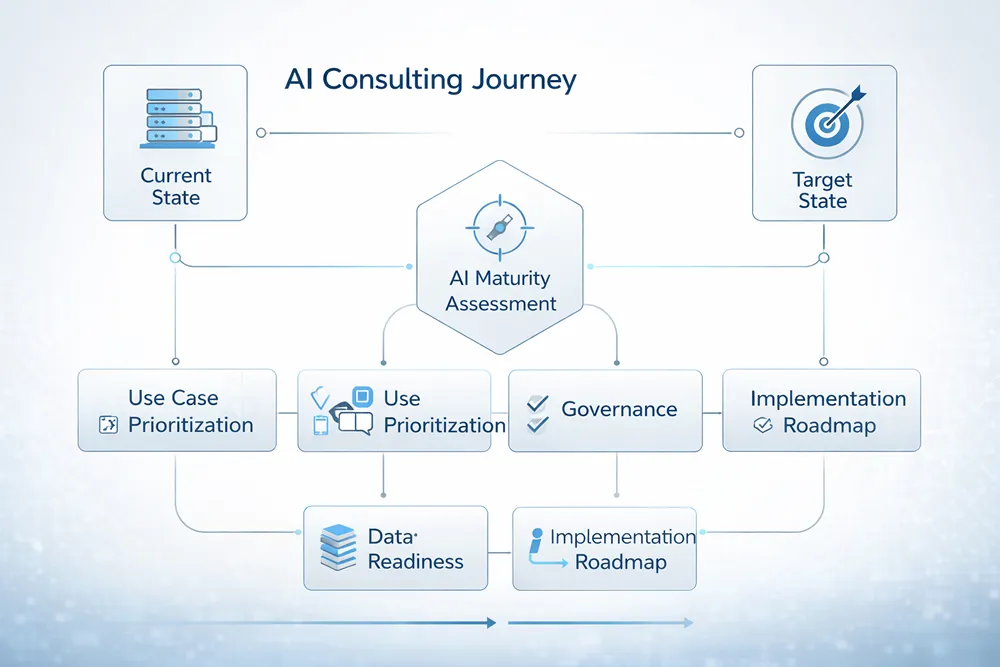
AI strategy consulting provides expert guidance for organizations developing roadmaps to adopt AI technologies and integrate them into core business operations. Unlike tactical AI implementation services that focus on specific technical deployments, ai strategy consulting addresses fundamental questions about where, how, and why to invest in artificial intelligence. Consultants help companies assess their AI maturity, identify high-value use cases, prioritize initiatives, and develop governance frameworks that ensure responsible ai implementation aligned with organizational values and regulatory requirements.
The need for specialized ai consulting stems from the unique challenges AI presents compared to traditional technology investments. AI capabilities span an enormous range—from machine learning models that optimize logistics to generative ai systems that transform content creation, from predictive analytics that forecast demand to ai agents that autonomously execute complex workflows. Most organizations lack the internal expertise to evaluate these options, understand their technical requirements, assess implementation risks, and project realistic returns on investment. According to MIT Sloan Management Review, fewer than 10% of companies achieve significant business value from AI investments, with strategic misalignment being the primary cause of failure.
AI strategy consulting services bridge this expertise gap by combining deep technical knowledge with business acumen. Consultants help organizations move beyond technology-first thinking to business-value-first approaches that identify problems worth solving before selecting AI solutions. This strategic perspective prevents common pitfalls like implementing AI for impressive but low-value use cases, underestimating data requirements, neglecting change management, or failing to establish the organizational capabilities needed to sustain AI initiatives over time. Companies working with experienced ai consultants develop comprehensive ai strategies that balance ambition with pragmatism, creating realistic transformation roadmaps that deliver incremental value while building toward long-term competitive advantage.
How Does AI Strategy Consulting Drive Digital Transformation?
Digital transformation strategy has evolved significantly with the emergence of powerful AI capabilities. While earlier digital transformation efforts focused on cloud migration, process digitization, and customer experience improvements through digital channels, modern transformation strategies place AI at the center of business model innovation. AI-powered systems don't merely digitize existing processes—they fundamentally redefine how work gets done, how decisions are made, and how value is created for customers.
AI strategy consulting accelerates digital transformation by identifying opportunities where artificial intelligence creates step-change improvements rather than incremental gains. For example, traditional process optimization might reduce customer service response times by 20% through better workflow management. In contrast, intelligent automation using conversational AI can handle 70-80% of routine inquiries entirely autonomously, freeing human agents to focus on complex, high-value interactions. This transformative impact extends across functions—AI-powered predictive analytics transform supply chain management, generative AI revolutionizes content operations, and advanced analytics unlock insights from data that previously remained untapped.
The transformation journey requires coordinated changes across technology, processes, people, and culture. Strategy consultants develop holistic digital transformation consulting services that address all these dimensions. Technology roadmaps ensure infrastructure can support AI workloads, data platforms provide the foundation for model training and inference, and integration architectures connect AI capabilities with existing systems. Process redesign adapts workflows to leverage AI capabilities effectively rather than simply automating existing inefficient processes. Organizational transformation includes upskilling programs, new role definitions, and change management initiatives that help employees embrace AI augmentation rather than resist it. Companies pursuing enterprise generative AI development particularly benefit from comprehensive strategies addressing these interconnected transformation elements.
What Are the Key Components of a Comprehensive AI Strategy?
A comprehensive ai strategy encompasses multiple interconnected elements that together enable successful AI transformation. Vision and objectives form the foundation, articulating how AI will advance organizational goals and create competitive advantage. This vision should be specific enough to guide decision-making yet flexible enough to adapt as AI technologies and business conditions evolve. Leading companies frame AI vision around business outcomes—revenue growth, cost reduction, customer experience enhancement, risk mitigation—rather than technical capabilities.
Use case identification and prioritization translates strategic vision into actionable initiatives. Strategy consulting services employ structured frameworks to systematically evaluate potential AI applications across all business functions. Each use case is assessed on multiple dimensions: business value potential, technical feasibility, data availability, implementation complexity, and strategic alignment. This rigorous prioritization ensures resources flow to initiatives delivering maximum impact rather than spreading efforts across too many low-value projects. The Boston Consulting Group (BCG) emphasizes that successful AI adopters concentrate investments on 3-5 transformational use cases rather than pursuing dozens of small experiments simultaneously.
Technical and organizational enablers comprise the third component. Technical enablers include data infrastructure, AI platforms, development environments, and integration architectures that support building and deploying AI solutions at scale. Data governance frameworks ensure data quality, security, privacy, and ethical use. Organizational enablers encompass talent strategies (build, buy, or partner decisions), operating models defining how AI development teams interact with business units, and governance structures establishing decision rights and accountability for AI initiatives. Finally, implementation roadmaps sequence initiatives, establish milestones, define success metrics, and create feedback loops that enable continuous strategy refinement based on results. Organizations can enhance strategy execution through specialized AI consulting services providing ongoing guidance throughout implementation.
How Do AI Consultants Help Companies Integrate AI Into Existing Operations?
Integrating AI into existing operations presents significant challenges beyond the technical work of model development and deployment. Most organizations have decades of accumulated technical debt, complex legacy systems with limited documentation, and deeply entrenched business processes optimized for human execution. AI consultants help navigate these challenges through systematic integration approaches that minimize disruption while maximizing value realization.
Integration strategy begins with architecture assessment, mapping current systems, data flows, and integration points. Consultants identify where AI capabilities can plug into existing workflows versus where processes require redesign to fully leverage AI potential. Modern integration patterns emphasize API-first architectures that expose AI functionality through well-defined interfaces, enabling gradual adoption across multiple applications. For example, a predictive model forecasting inventory needs might initially serve a single planning application, then expand to integrate with procurement systems, manufacturing scheduling, and financial planning as value is demonstrated and trust builds.
Change management and user experience design prove equally critical to successful integration. Even technically excellent AI implementations fail if users don't adopt them or if they create friction in established workflows. Consultants employ human-centered design approaches that involve end users throughout development, ensuring AI augments rather than frustrates their work. This includes designing intuitive interfaces, providing transparency into AI reasoning, enabling easy overrides when human judgment differs from AI recommendations, and establishing feedback mechanisms that capture user input for continuous improvement. Organizations successfully integrate AI when they view it as a sociotechnical system requiring coordinated changes in technology, processes, and people rather than purely a technical deployment challenge.
What Role Does Data Governance Play in AI Strategy?
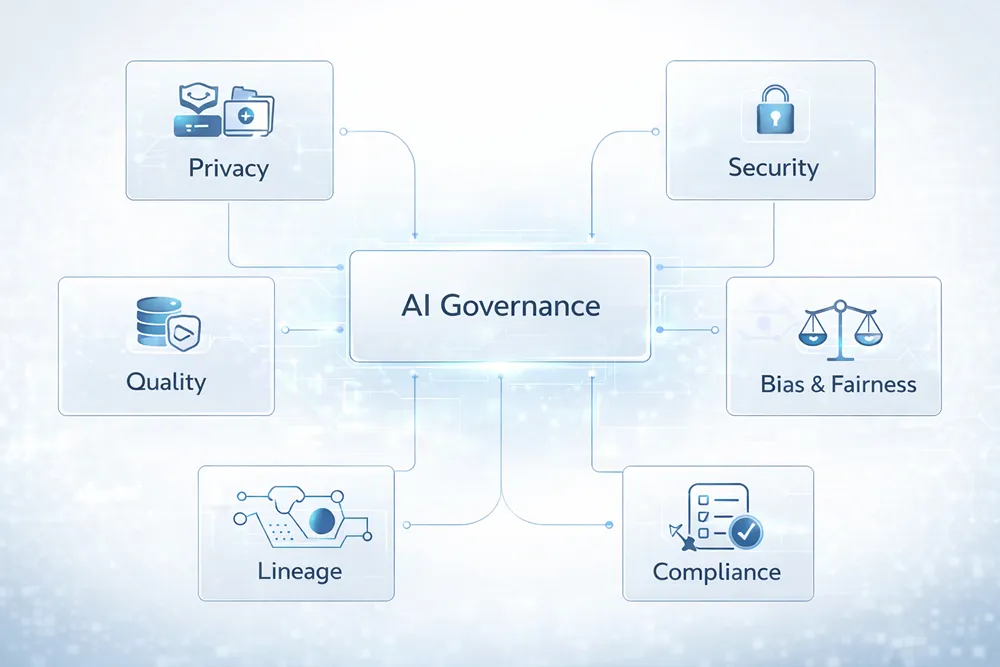
Data governance forms the foundation of sustainable AI strategy, establishing policies, standards, and controls that ensure data quality, security, privacy, and ethical use. Without robust data governance, AI initiatives face numerous risks: models trained on poor-quality data produce unreliable results, privacy violations create regulatory exposure, biased data perpetuates unfair outcomes, and inadequate security leaves organizations vulnerable to data breaches that compromise both AI systems and underlying data assets.
Effective governance frameworks address multiple dimensions of responsible AI deployment. Data quality governance establishes standards for completeness, accuracy, consistency, and timeliness of data used in AI applications. This includes automated quality monitoring, data lineage tracking that traces data from sources through transformations to model inputs, and remediation processes for identified quality issues. Privacy governance implements controls ensuring AI complies with regulations like GDPR, CCPA, and industry-specific requirements. Techniques include data minimization (using only necessary data), anonymization or pseudonymization for sensitive information, and consent management tracking permissions for data use.
Ethics and bias governance addresses fairness concerns inherent in AI systems. This encompasses bias testing across demographic dimensions, fairness metrics appropriate to specific use cases, and mitigation strategies when biases are detected. Security governance protects AI systems and data from unauthorized access, adversarial attacks designed to manipulate model outputs, and data poisoning attempts that corrupt training data. The National Institute of Standards and Technology (NIST) provides comprehensive AI risk management frameworks that leading organizations adapt to their specific contexts. Companies implementing robust governance position themselves for scalable AI adoption while mitigating regulatory, reputational, and operational risks.
How Can Organizations Leverage Generative AI for Strategic Advantage?
Generative AI represents a paradigm shift in AI capabilities, enabling applications previously impossible with traditional AI approaches. Unlike discriminative models that classify or predict based on existing data, generative AI creates new content—text, images, code, designs, synthetic data—opening vast new possibilities for automation, augmentation, and innovation. Forward-thinking organizations leverage these capabilities to redefine competitive positioning across multiple dimensions.
Content operations experience revolutionary transformation through generative AI. Marketing teams use AI to generate personalized content at scale—customized email campaigns, social media posts, product descriptions, and advertising creative tailored to individual customer segments. This personalization previously achievable only for high-value customers extends to entire customer bases, dramatically improving engagement and conversion. Customer service operations deploy conversational AI that handles routine inquiries naturally while seamlessly escalating complex issues to human agents. The Harvard Business Review reports companies implementing generative AI in customer-facing operations achieve 30-50% cost reductions while simultaneously improving customer satisfaction through faster response times and 24/7 availability.
Knowledge work acceleration represents another strategic lever. Developers using AI coding assistants write software 40-55% faster while maintaining code quality. Financial analysts employ AI to draft research reports, synthesize earnings call transcripts, and generate investment theses for human review and refinement. Legal teams leverage AI for contract drafting, due diligence document review, and legal research. These productivity multipliers enable smaller teams to accomplish more, accelerate time-to-market for new products and services, and free high-value talent for strategic work requiring uniquely human judgment. Organizations can integrate generative ai capabilities systematically through process orchestration platforms that coordinate AI services across enterprise workflows.
What Are Transformation Strategies for AI and GenAI Implementation at Scale?
Scaling AI from pilot projects to enterprise-wide deployment requires deliberate transformation strategies addressing technical, organizational, and governance challenges. Many organizations struggle in this "valley of death" between successful proofs-of-concept and production systems delivering business value at scale. Transformation strategies help organizations cross this valley through systematic approaches that build capabilities incrementally while maintaining momentum.
The platform approach represents one effective transformation strategy. Rather than building custom infrastructure for each AI use case, organizations invest in shared AI platforms providing common capabilities—data pipelines, model development environments, deployment infrastructure, monitoring tools, and governance controls. This platform enables multiple teams to develop and deploy ai solutions rapidly while maintaining consistency, security, and compliance. Platform investments require significant upfront costs but dramatically reduce the marginal cost of each additional AI application, enabling the portfolio approach necessary for enterprise-wide transformation.
Centers of excellence (CoE) combined with federated delivery models balance centralized expertise with decentralized innovation. The CoE establishes standards, provides training, develops reusable components, and tackles complex technical challenges beyond individual team capabilities. Federated teams embedded in business units identify use cases, develop solutions leveraging CoE resources, and ensure implementations align with local needs. This model accelerates adoption by removing bottlenecks that occur when all AI work funnels through a central team while maintaining quality and governance standards. Organizations successfully deploy ai solutions at scale typically combine platform investments with CoE organizational models, supported by executive sponsorship that secures necessary resources and removes organizational obstacles.
How Do AI Strategy Consultants Measure and Optimize ROI?
Measuring return on investment for AI initiatives presents unique challenges compared to traditional technology projects. AI benefits often manifest as productivity improvements, enhanced decision quality, faster time-to-market, or improved customer experience rather than direct cost savings. Additionally, AI implementations typically require substantial upfront investment in infrastructure, data preparation, and organizational change before delivering returns, creating negative cash flows that can test organizational patience.
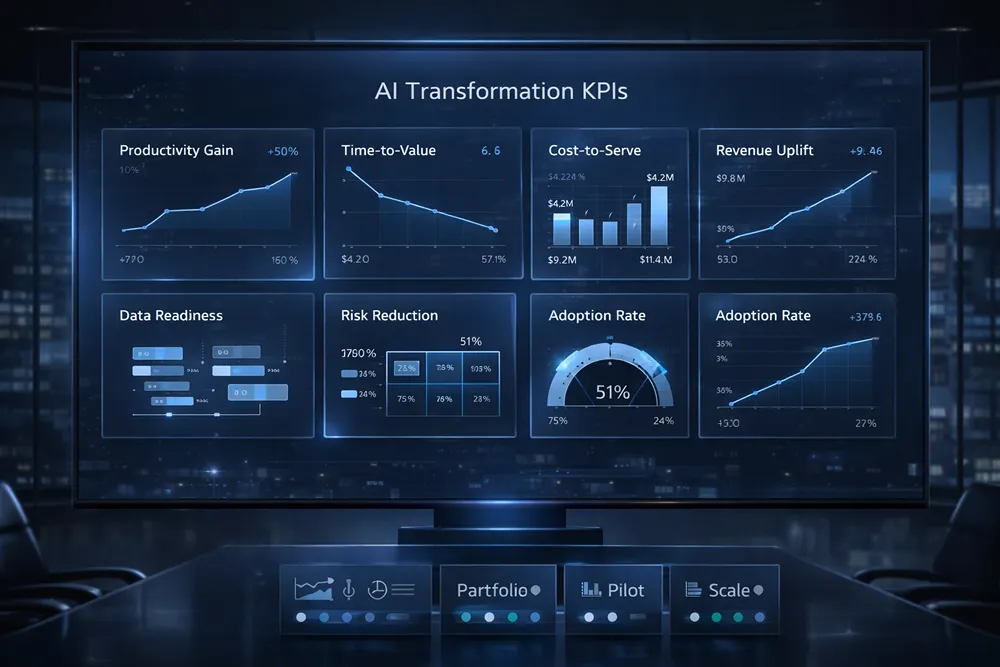
Leading strategy consultants establish comprehensive measurement frameworks capturing both tangible financial returns and strategic value creation. Financial metrics include direct cost savings from automation, revenue increases from improved personalization or faster innovation cycles, and risk reduction from enhanced fraud detection or predictive maintenance. These metrics require baselines established before AI implementation and rigorous attribution methodologies distinguishing AI impact from confounding factors. For example, revenue growth following AI-powered personalization must account for seasonal variations, market trends, and other concurrent initiatives to isolate AI contribution accurately.
Strategic value metrics complement financial measures by capturing competitive positioning improvements, organizational capability development, and option value from AI investments. Competitive metrics might track market share changes, customer satisfaction improvements relative to competitors, or time-to-market advantages for new products. Capability metrics assess organizational AI maturity growth, portfolio of deployable AI models, and employee skill development. Option value recognizes that early AI investments create platforms and expertise enabling future innovations whose value isn't fully quantifiable initially. The McKinsey Global Institute recommends balanced scorecards combining financial, operational, and strategic metrics to optimize AI portfolio decisions and demonstrate comprehensive business value from AI transformation investments.
What Should Organizations Look for in an AI Strategy Consulting Partner?
Selecting the right consulting partner significantly impacts AI transformation success. Organizations should evaluate potential partners across multiple dimensions reflecting both technical capabilities and business acumen. Deep AI expertise forms the foundation—consultants should demonstrate current knowledge of AI technologies spanning machine learning, generative AI, computer vision, natural language processing, and emerging capabilities like ai agents. However, technical expertise alone proves insufficient; consultants must translate technical possibilities into business value propositions that resonate with executives and operational leaders.
Industry experience and domain knowledge enable consultants to quickly understand organizational context, identify relevant use cases, and anticipate implementation challenges specific to your sector. A consultant with financial services experience understands regulatory constraints, risk management imperatives, and customer expectations differently than one primarily serving retail or manufacturing clients. Request case studies demonstrating measurable outcomes in organizations similar to yours, focusing on scale and complexity comparable to your environment rather than just impressive brand names.
Methodology and approach reveal how consultants structure engagements and collaborate with client teams. Look for systematic frameworks balancing strategic thinking with execution pragmatism. Evaluate their approach to knowledge transfer—do they build internal capabilities enabling self-sufficiency, or do they create dependency relationships? Assess cultural fit through interactions with potential team members who would work on your engagement. Finally, consider the partner's ecosystem relationships with AI technology providers, cloud platforms, and implementation partners. Leading ai strategy firms maintain close relationships with innovators, providing clients early access to emerging capabilities and preferential terms. The World Economic Forum emphasizes that successful AI transformation requires consulting partners who combine technical excellence with business strategy expertise and genuine commitment to building client capabilities rather than maximizing consulting revenues.
How Does AI Strategy Enable Competitive Advantage and Value Creation?
AI strategy creates competitive advantage through multiple mechanisms that compound over time when executed effectively. Operational efficiency improvements represent the most direct path to value creation. AI-powered automation reduces costs by handling routine tasks faster and more accurately than human workers. Predictive analytics optimize resource allocation, reducing waste and improving asset utilization. These efficiency gains flow directly to bottom-line profitability while freeing resources for growth investments.
Customer experience differentiation provides a second source of competitive advantage. AI enables personalization at scales previously impossible, tailoring products, services, and interactions to individual customer preferences and contexts. Recommendation systems guide customers to relevant offerings, conversational AI provides instant support, and predictive models anticipate needs before customers articulate them. Companies delivering superior user experience through AI capabilities command premium pricing, achieve higher customer retention, and benefit from positive word-of-mouth that reduces customer acquisition costs. According to research from Accenture, companies leading in AI-driven customer experience grow revenue 2-3x faster than industry peers.
Innovation acceleration and business model evolution represent the most transformative sources of competitive advantage. AI enables entirely new products and services impossible without these capabilities—autonomous vehicles, real-time language translation, personalized medicine, and adaptive education platforms exemplify AI-native innovations reshaping industries. Beyond new offerings, AI transforms business models by enabling outcome-based pricing, predictive maintenance as a service, and AI-augmented marketplaces. Organizations that successfully adopt ai technologies and business models together create defensible competitive positions that prove difficult for incumbents to replicate, establishing themselves as market leaders in AI-enabled industries.
What Are Common Pitfalls in AI Transformation and How Can Strategy Consulting Help Avoid Them?
AI transformation initiatives fail for predictable reasons that experienced strategy consultants help organizations avoid. Technology-first thinking represents perhaps the most common pitfall. Organizations become enamored with impressive AI capabilities—often generative AI demonstrations—and rush to implement without clearly defining business problems or success criteria. This results in solutions seeking problems, impressive demos that never reach production, and wasted resources on low-value applications. Strategy consulting reorients efforts around business value, ensuring technical implementations serve strategic objectives.
Underestimating organizational change requirements causes many technically successful AI projects to fail at adoption. Users resist AI recommendations they don't understand, processes designed for human execution break when automated, and governance structures lack clarity about accountability for AI decisions. Consultants address these challenges through comprehensive change management strategies that prepare organizations for transformation. This includes stakeholder engagement securing buy-in, training programs building AI literacy, process redesign optimizing for AI-human collaboration, and governance frameworks establishing clear decision rights and accountability.
Inadequate data strategies doom AI initiatives regardless of algorithm sophistication. Organizations discover too late that required data doesn't exist, quality is insufficient, silos prevent access, or privacy constraints prohibit intended uses. Leading consulting partners conduct thorough data readiness assessments early in strategy development, identifying gaps and establishing remediation roadmaps before committing to specific AI applications. They also help organizations implement data governance frameworks preventing future data-related obstacles. Finally, consultants mitigate the "pilot purgatory" trap where organizations run endless experiments without scaling successful ones. By establishing clear criteria for pilot success, defining scaling pathways from inception, and securing executive commitment to scale what works, consultants help organizations move from experimentation to value realization systematically.
Frequently Asked Questions About AI Strategy Consulting
How long does it typically take to develop and implement an AI strategy?
Strategy development typically requires 8-12 weeks for comprehensive assessment, vision development, roadmap creation, and organizational alignment. However, implementation spans 18-36 months for enterprise-wide transformation, with initial value delivery often occurring within 6-9 months through quick-win initiatives that build momentum and funding for larger investments.
Should organizations build internal AI capabilities or rely on consulting partners long-term?
The optimal approach combines both. Organizations should build core strategic capabilities—understanding AI potential, identifying use cases, governing implementations—while leveraging partners for specialized technical expertise, accelerated delivery, and access to best practices across industries. This hybrid model provides flexibility while avoiding excessive dependency on external resources.
How much should companies budget for AI transformation initiatives?
Leading organizations typically allocate 5-15% of IT budgets to AI initiatives, though this varies significantly by industry and transformation ambition. Initial strategy engagements might require $200,000-$500,000, while comprehensive transformation programs spanning multiple years could involve tens of millions in technology, consulting, and organizational change investments.
What organizational structure works best for AI transformation?
Most successful organizations employ hybrid models with centralized AI centers of excellence providing platforms, standards, and specialized expertise, combined with federated teams embedded in business units who identify use cases and deliver solutions. This balances standardization benefits with business unit agility and ensures AI initiatives align with operational realities.
How can organizations measure AI transformation success beyond financial ROI?
Comprehensive measurement frameworks include operational metrics (productivity improvements, error reduction, process cycle time), customer metrics (satisfaction scores, Net Promoter Score, engagement rates), innovation metrics (time-to-market, new product success rates), and capability metrics (AI maturity levels, skill development, deployed model portfolio). These provide a holistic view of transformation progress and value creation.
Key Takeaways: Essential Points for Successful AI Strategy and Transformation
- AI strategy consulting services provide expert guidance for navigating the complex journey from AI exploration to enterprise-wide implementation, developing comprehensive frameworks aligning technology capabilities with business objectives and ensuring responsible AI adoption
- Digital transformation strategy increasingly centers on artificial intelligence as the primary enabler of business model innovation, operational efficiency, and customer experience differentiation rather than merely supporting traditional transformation initiatives
- Comprehensive AI strategies encompass vision and objectives, use case prioritization, technical and organizational enablers, data governance frameworks, and implementation roadmaps that sequence initiatives for maximum value creation
- Integrating AI into existing operations requires systematic approaches addressing technical architecture, change management, and user experience design to ensure AI augments rather than disrupts established workflows
- Data governance frameworks establish the foundation for sustainable AI adoption by ensuring data quality, security, privacy, and ethical use while mitigating regulatory, reputational, and operational risks
- Generative AI capabilities enable revolutionary transformation in content operations, knowledge work, and customer experience, creating competitive advantages through personalization at scale and dramatic productivity improvements
- Transformation strategies for scaling AI emphasize platform approaches providing shared infrastructure, centers of excellence establishing standards and expertise, and federated delivery models balancing centralization with business unit autonomy
- Measuring AI ROI requires comprehensive frameworks capturing financial returns, operational improvements, strategic value creation, and organizational capability development beyond traditional cost-benefit calculations
- Selecting consulting partners demands evaluation of technical AI expertise, industry experience, systematic methodology, knowledge transfer commitment, and ecosystem relationships that provide access to emerging capabilities
- Avoiding common pitfalls requires business-value-first thinking, comprehensive organizational change management, robust data strategies, and clear pathways from pilots to scaled implementations delivering measurable business value
The ai transformation journey represents one of the most significant strategic imperatives facing organizations across industries. Companies that successfully leverage artificial intelligence consulting expertise to develop and execute comprehensive strategies position themselves for sustainable competitive advantage in increasingly AI-enabled markets. By focusing on high-value use cases, building scalable platforms and organizational capabilities, implementing robust governance, and maintaining unwavering commitment to responsible AI practices, organizations can unlock the transformative potential of AI and genai technologies. The key lies not in chasing every AI innovation but in thoughtfully implementing tailored ai solutions aligned with strategic objectives and supported by the technical, data, and organizational foundations necessary for sustained success. Strategy consulting services accelerate this journey by bringing proven frameworks, deep expertise, and cross-industry insights that help organizations avoid costly mistakes and achieve faster time-to-value from AI investments.
