The artificial intelligence revolution has entered a transformative phase with generative AI technology reshaping how businesses operate, innovate, and compete. Generative AI consulting services bridge the gap between cutting-edge AI capabilities and practical business applications, helping organizations harness the power of generative models to drive growth, efficiency, and innovation. This comprehensive guide explores how generative AI consulting companies deliver value through strategic planning, custom AI solution development, responsible AI implementation, and ongoing optimization. Whether you're exploring initial AI adoption or seeking to scale gen AI initiatives across your enterprise, understanding the benefits of generative AI consulting services is essential for maximizing return on investment and staying competitive in an AI-driven marketplace.
What Are Generative AI Consulting Services and Why Do Businesses Need Them?
Generative AI consulting services provide expert guidance and technical implementation support for organizations seeking to leverage generative artificial intelligence capabilities. These services help businesses navigate the complex landscape of AI technologies, from strategy formulation and use case identification to model development, deployment, and governance. A generative AI consulting company brings deep AI expertise across machine learning frameworks, large language models, diffusion models, and other generative models that create new content, code, designs, or data.
The need for specialized genai consulting stems from the unique challenges generative AI presents compared to traditional AI applications. Organizations must understand which generative AI models suit their specific requirements, how to integrate these AI systems with existing infrastructure, and how to implement responsible AI practices that address bias, privacy, and ethical concerns. According to McKinsey Global Institute, companies that successfully implement gen AI solutions can capture value equivalent to 15-40% of their total operating costs, but achieving this requires sophisticated strategy and execution.
Generative AI consulting services deliver comprehensive support spanning the entire AI lifecycle. This includes assessing organizational readiness, identifying high-impact ai use cases, selecting appropriate AI tech stack components, developing custom AI models, integrating generative ai into workflows, training teams, and establishing governance frameworks. For organizations lacking internal AI expertise, partnering with an AI consulting company accelerates time-to-value while mitigating implementation risks. These consulting and development services ensure that AI initiatives align with business objectives and deliver measurable outcomes rather than becoming expensive experiments that fail to produce results.
How Do Generative AI Development Services Transform Business Operations?
Generative AI development services create custom solutions tailored to specific business challenges and opportunities. Unlike off-the-shelf AI software, custom generative AI solutions address unique organizational requirements, industry-specific workflows, and proprietary data characteristics. Development services encompass everything from strategy and model development to deployment, monitoring, and continuous improvement of AI systems.
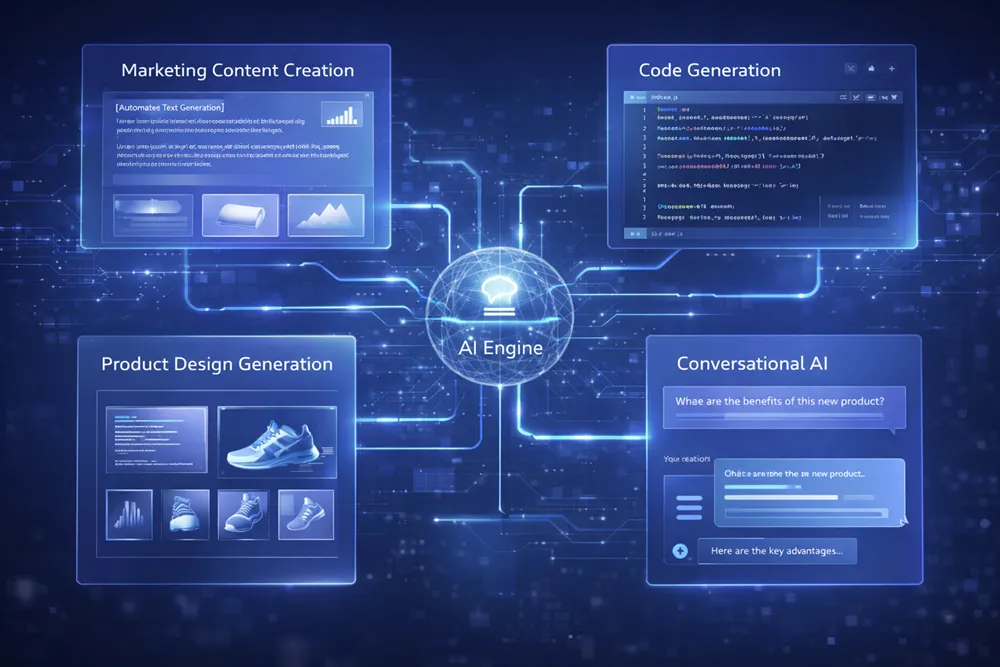
The transformation begins with identifying processes where AI can improve efficiency, quality, or innovation. Common generative ai applications include automated content creation for marketing teams, code generation to accelerate software development, design assistance for creative professionals, customer service automation through conversational AI, and data synthesis for training other machine learning models. Each application requires careful consideration of the right generative ai model architecture, training data requirements, and integration approaches.
Custom AI model development involves selecting base models—such as GPT, BERT, or domain-specific alternatives—and fine-tuning them on proprietary data to optimize performance for specific tasks. This process requires ai expertise in data preparation, model training, evaluation metrics, and deployment architectures. Leading generative ai consulting teams employ rigorous testing methodologies to ensure models produce accurate, relevant, and safe outputs before production deployment. Organizations implementing enterprise generative AI development typically see 30-50% productivity improvements in targeted workflows, according to research from Gartner, though results vary significantly based on implementation quality and change management effectiveness.
What Is the Difference Between Traditional AI and Generative AI Solutions?
Traditional AI systems primarily focus on classification, prediction, and pattern recognition tasks. These discriminative models analyze existing data to make decisions—for example, determining whether an email is spam, predicting customer churn likelihood, or identifying objects in images. Traditional ai approaches excel at well-defined tasks with clear right and wrong answers, requiring labeled training data that maps inputs to desired outputs.
Generative AI solution architectures fundamentally differ by creating new content rather than merely analyzing existing data. Generative models learn the underlying patterns and distributions within training data, then generate novel outputs that share statistical properties with the training set while being entirely new creations. This capability enables applications impossible with traditional AI, such as drafting unique marketing copy, generating custom software code, creating product designs, or synthesizing realistic images based on text descriptions.
The ai technologies underlying generative systems employ different architectural approaches than traditional AI. Transformer-based models like GPT use attention mechanisms to understand context and generate coherent text sequences. Diffusion models gradually refine random noise into detailed images through learned denoising processes. Variational autoencoders (VAEs) and generative adversarial networks (GANs) employ encoder-decoder architectures or adversarial training to create new data samples. Understanding these architectural differences helps organizations select appropriate genai solution approaches for specific use cases. The Stanford Institute for Human-Centered Artificial Intelligence (HAI) provides extensive research on the capabilities and limitations of different generative model architectures.
How Do AI Consulting Companies Develop Custom Gen AI Strategies?
AI consulting companies begin strategy development with comprehensive discovery processes that assess organizational readiness, technical infrastructure, data assets, and strategic objectives. This assessment identifies where AI initiatives can deliver maximum business impact while considering factors like data availability, technical feasibility, regulatory constraints, and change management requirements. The goal is creating gen ai strategies that align with business priorities rather than implementing technology for its own sake.
Custom strategies address multiple dimensions of successful AI adoption. Technology selection involves evaluating generative ai models, determining whether to use pre-trained models or develop custom solutions, and designing the ai tech stack that will support development and deployment. Data strategy covers data collection, quality improvement, privacy preservation, and synthetic data generation to augment limited datasets. Organizational strategy encompasses talent development, governance frameworks, ethical guidelines, and change management approaches that prepare teams for AI-augmented workflows.
Implementation roadmaps prioritize ai use cases based on value potential, implementation complexity, and strategic fit. Quick wins that demonstrate value with limited risk typically come first, building organizational confidence and funding for more ambitious initiatives. The roadmap also addresses technical dependencies, ensuring infrastructure, data pipelines, and integration capabilities are ready when needed. Generative ai consultants facilitate stakeholder alignment, securing executive sponsorship and cross-functional collaboration essential for enterprise ai success. Organizations can complement strategic planning with AI consulting services that provide ongoing guidance throughout implementation.
What Are the Key Benefits of Generative AI for Enterprise Applications?
The benefits of generative ai extend across virtually every business function, from customer-facing operations to internal processes. Content generation capabilities dramatically accelerate marketing, sales, and customer service operations. Marketing teams use generative ai to create personalized email campaigns, social media posts, product descriptions, and advertising copy at scale. Sales teams leverage AI to draft customized proposals, generate presentation content, and automate follow-up communications. Customer service operations deploy conversational AI that handles routine inquiries, freeing human agents for complex issues requiring empathy and judgment.
Software development experiences transformative productivity gains through AI-powered code generation and assistance. Developers use generative ai applications to autocomplete code, generate boilerplate functions, explain complex codebases, identify bugs, and suggest optimizations. These AI copilots don't replace developers but amplify their capabilities, enabling small teams to accomplish what previously required much larger groups. Research from GitHub indicates developers using AI coding assistants complete tasks 55% faster while reporting higher job satisfaction.
Knowledge work across functions benefits from generative AI's ability to synthesize information, generate insights, and automate routine cognitive tasks. Financial analysts use AI to summarize earnings reports and generate investment research. Legal teams employ AI to draft contracts and analyze case law. HR departments leverage AI for job descriptions, candidate screening, and personalized learning content. The cumulative effect of these productivity improvements creates competitive advantages for organizations that successfully implement generative ai solutions and consulting approaches. Additionally, integrating AI agents development services enables autonomous task execution that further amplifies productivity gains.
How Do Generative AI Consultants Ensure Responsible AI Implementation?
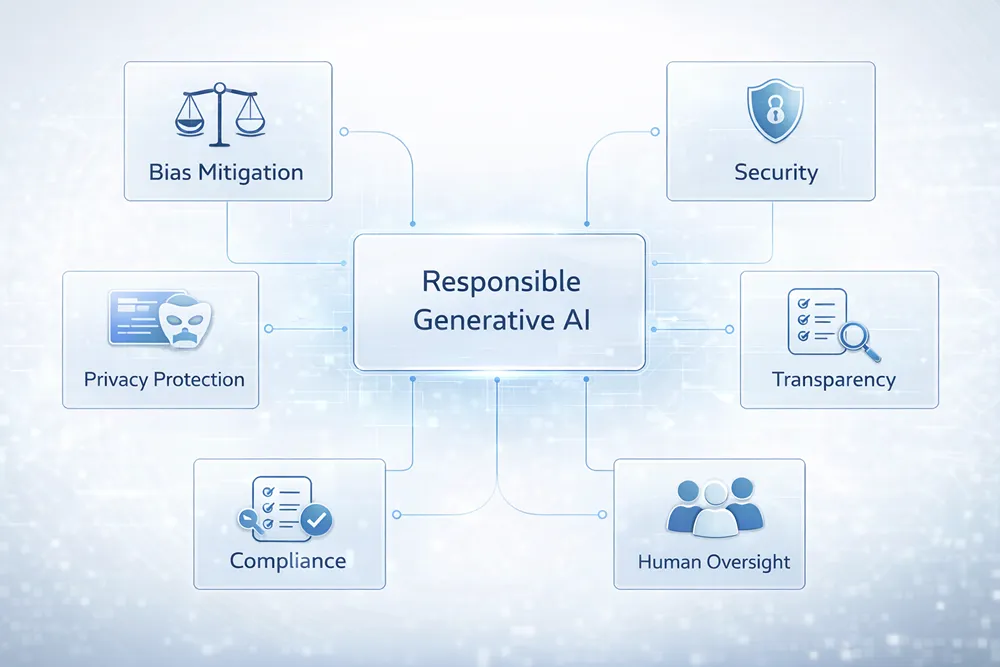
Responsible AI practices form the foundation of sustainable generative ai implementation, addressing ethical concerns, bias mitigation, privacy protection, and transparency requirements. Generative ai consultants begin with governance frameworks that establish clear policies for AI development, deployment, and monitoring. These frameworks define acceptable use cases, prohibited applications, approval processes, and accountability structures that ensure AI systems align with organizational values and regulatory requirements.
Bias detection and mitigation represent critical components of responsible ai implementation. Generative models trained on internet-scale data inevitably absorb societal biases present in training corpora. Consultants employ multiple strategies to address bias, including carefully curated training data, bias testing across demographic dimensions, fine-tuning to reduce problematic outputs, and human-in-the-loop validation for high-stakes applications. According to frameworks from the Partnership on AI, effective bias mitigation requires ongoing monitoring rather than one-time fixes, as model behavior can drift over time.
Privacy preservation techniques protect sensitive information while enabling valuable AI applications. Methods include differential privacy that adds mathematical noise to training data, federated learning that trains models without centralizing data, and synthetic data generation that creates realistic but artificial datasets for development and testing. Transparency and explainability mechanisms help stakeholders understand how AI systems make decisions, building trust and enabling compliance with regulations like the EU AI Act. Organizations implementing responsible ai practices not only mitigate risks but also build stakeholder confidence that supports broader AI adoption.
What Technologies and Tools Comprise a Modern AI Tech Stack?
A comprehensive ai tech stack integrates multiple technology layers supporting the full AI lifecycle from development through production deployment. The foundation layer includes cloud infrastructure from providers like AWS, Azure, or Google Cloud that provides computational resources for training and inference. GPU acceleration is essential for training large generative ai models, with options ranging from NVIDIA's H100 GPUs for cutting-edge performance to more cost-effective alternatives for smaller-scale deployments.
Model development tools include frameworks like PyTorch and TensorFlow that provide building blocks for creating and training generative models. Specialized libraries such as Hugging Face Transformers simplify working with pre-trained language models, while Stability AI's tools facilitate image generation tasks. MLOps platforms like MLflow, Weights & Biases, and Kubeflow orchestrate the machine learning lifecycle, managing experiments, tracking model versions, and automating deployment pipelines. These tools enable data scientists to iterate quickly while maintaining reproducibility and governance.
The integration and orchestration layer connects AI capabilities with existing business systems and workflows. API gateways expose AI functionality to applications, while orchestration platforms coordinate multi-step AI workflows. Vector databases like Pinecone, Weaviate, or Chroma enable retrieval-augmented generation (RAG) architectures that ground AI responses in organizational knowledge bases. Monitoring and observability tools track model performance, detect drift, and identify issues requiring intervention. Process orchestration platforms integrate these components into cohesive systems that deliver business value. The Cloud Native Computing Foundation (CNCF) provides resources for architecting scalable, production-ready AI infrastructure.
How Can Organizations Scale Gen AI Solutions Across the Enterprise?
Scaling gen ai from pilot projects to enterprise-wide deployment requires systematic approaches addressing technical, organizational, and governance dimensions. Technical scaling involves transitioning from prototype implementations to production-grade infrastructure that handles enterprise volumes, ensures reliability, and maintains performance. This includes optimizing inference costs through model compression, caching, and efficient serving architectures that balance quality with computational efficiency.
Organizational scaling demands change management strategies that prepare employees for AI-augmented workflows. This encompasses training programs that build AI literacy across the workforce, not just technical teams. Employees need to understand what ai can transform in their roles, how to effectively collaborate with AI systems, and when human judgment should override AI recommendations. Centers of excellence (CoEs) centralize AI expertise while supporting decentralized implementation across business units, balancing efficiency with customization for specific departmental needs.
Governance scaling establishes consistent policies, standards, and approval processes that maintain responsible ai practices as AI adoption expands. This includes model risk management frameworks, regular bias audits, privacy impact assessments, and compliance verification procedures. Organizations that successfully scale gen ai typically establish AI steering committees with cross-functional representation that balance innovation with risk management. They also implement portfolio management approaches that prioritize AI initiatives based on strategic value, allocate resources effectively, and retire underperforming projects. Research from MIT Sloan Management Review indicates that organizations with mature scaling capabilities achieve 3x greater returns from AI investments than those treating each project as isolated experiments.
What Industries Benefit Most from Generative AI Consulting Services?
While generative ai applications span virtually every sector, certain industries experience particularly transformative impacts from AI adoption. Financial services leverage generative AI for fraud detection narrative generation, automated financial reporting, personalized investment advice, and regulatory compliance documentation. Banks use AI to draft loan applications, generate risk assessments, and create customer communications tailored to individual financial situations and preferences.
Healthcare organizations employ generative AI for clinical documentation, medical imaging analysis, drug discovery acceleration, and personalized treatment planning. AI assists physicians by generating differential diagnoses, summarizing patient histories, and drafting clinical notes from appointment recordings. Pharmaceutical companies use generative models to design novel molecular compounds, dramatically accelerating early-stage drug development. The National Institutes of Health (NIH) supports research exploring AI applications in precision medicine and diagnostic assistance.
Manufacturing and engineering sectors benefit from generative AI through design optimization, predictive maintenance documentation, supply chain planning, and quality assurance. Generative design tools create innovative product configurations optimized for specific performance criteria and manufacturing constraints. Media and entertainment industries use AI for content creation, script development, visual effects generation, and personalized content recommendations. Retail organizations leverage AI for product descriptions, marketing content, virtual shopping assistants, and demand forecasting. Regardless of industry, successful implementations require customized generative ai solutions that address sector-specific requirements, regulations, and workflows rather than generic approaches.
How Do Generative AI Consulting Services Deliver Measurable ROI?
AI consulting services deliver measurable return on investment through multiple value creation mechanisms. Direct productivity improvements represent the most immediate and quantifiable benefits. When content creators generate marketing materials 10x faster, developers write code 2x more efficiently, or customer service teams handle 3x more inquiries, the labor cost savings and throughput increases translate directly to financial returns. These productivity gains compound across the organization as AI adoption expands.
Revenue enhancement opportunities emerge from AI-enabled capabilities that weren't previously feasible. Personalization at scale allows organizations to tailor offerings to individual customers' preferences, increasing conversion rates and customer lifetime value. Faster innovation cycles enabled by AI-assisted design and development help organizations bring products to market more quickly, capturing first-mover advantages. Enhanced customer experiences through always-available AI assistance and rapid problem resolution improve retention and generate positive word-of-mouth referrals.
Risk reduction and compliance benefits also contribute to ROI, though they're harder to quantify. AI-powered monitoring detects fraud, security threats, and compliance violations faster than manual processes, minimizing potential losses. Automated documentation and audit trail generation reduce compliance costs while improving accuracy. The value of generative ai includes avoiding costly mistakes, regulatory penalties, and reputational damage. Successful AI consulting partner relationships establish clear metrics at project inception, baseline current performance, and track improvements systematically, enabling data-driven decisions about continued investment and expansion. Consulting services help businesses develop measurement frameworks that capture both tangible financial returns and strategic benefits like competitive positioning and organizational learning.

What Should Organizations Look for When Selecting a Generative AI Consulting Company?
Selecting the right generative AI consulting company requires evaluating multiple dimensions of capability and fit. Technical expertise forms the foundation—consultants should demonstrate deep knowledge of generative models, modern AI architectures, and production deployment practices. Ask about their experience with specific model types relevant to your use cases, their approach to custom model development versus fine-tuning pre-trained models, and their strategies for optimizing inference costs while maintaining quality.
Industry experience proves crucial for successful implementations. Consultants familiar with your sector understand domain-specific challenges, regulatory requirements, and workflow nuances that generic AI expertise might overlook. Request case studies and references from organizations similar to yours, focusing on measurable outcomes rather than just technology deployment. A generative ai consulting team with relevant industry background can identify opportunities and pitfalls that technical skills alone might miss.
Implementation methodology reveals how consultants approach projects and collaborate with client teams. Look for structured approaches that include discovery, strategy, proof-of-concept, pilot, and scaling phases with clear decision gates. Evaluate their commitment to implement responsible ai practices, knowledge transfer approaches that build internal capabilities, and post-deployment support models. Cultural fit matters significantly—consultants will work closely with your teams, so alignment on communication styles, values, and working approaches supports smoother collaboration. Finally, consider the consultant's ecosystem relationships with AI technology vendors, which can provide access to early capabilities, preferential pricing, or technical support channels. Organizations should also assess whether the consulting and development services are tailored to organizational scale and maturity rather than one-size-fits-all offerings.
Frequently Asked Questions About Generative AI Consulting Services
How long does a typical generative AI implementation project take?
Project timelines vary significantly based on scope and complexity. Proof-of-concept projects demonstrating feasibility for specific use cases typically require 6-12 weeks. Pilot implementations that validate value with real users generally take 3-6 months. Enterprise-wide rollouts spanning multiple departments and use cases often extend 12-24 months, with phased deployments delivering incremental value throughout.
What data requirements exist for custom generative AI model development?
Data requirements depend on the approach. Fine-tuning existing models for specific tasks might require 1,000-10,000 high-quality examples. Training custom models from scratch demands orders of magnitude more data—potentially millions of examples. However, modern techniques like few-shot learning, transfer learning, and synthetic data generation can reduce data requirements significantly for many applications.
Can small and medium businesses benefit from generative AI consulting, or is it only for large enterprises?
Generative ai consulting services for enterprises certainly exists, but small and medium businesses increasingly access AI capabilities through consulting partnerships. Many consultants offer scalable engagement models and leverage pre-trained models that reduce costs. The key is identifying high-impact use cases where AI delivers value exceeding implementation costs, which exists across organizations of all sizes.
How do organizations protect proprietary data when using generative AI models?
Data protection strategies include deploying private AI instances within organizational infrastructure, using models that don't retain training data, implementing data anonymization techniques, and establishing contractual protections with vendors. Many organizations prefer on-premises or private cloud deployments for sensitive data rather than public AI services.
What ongoing costs should organizations expect after initial AI implementation?
Ongoing costs include inference computational expenses (typically the largest ongoing cost), model monitoring and maintenance, periodic retraining as data distributions shift, continuous improvement iterations, and team training. Cloud-based inference costs correlate with usage volumes, so successful implementations that see high adoption may experience increasing costs that still deliver positive ROI given productivity benefits.
Key Takeaways: Maximizing Value from Generative AI Consulting Services
- Generative AI consulting services provide comprehensive support spanning strategy, development, deployment, and governance, helping organizations successfully harness gen ai capabilities for competitive advantage
- Custom AI solutions tailored to specific business challenges deliver significantly better results than generic implementations, addressing unique organizational requirements, industry workflows, and data characteristics
- Generative artificial intelligence fundamentally differs from traditional AI by creating new content rather than just analyzing existing data, enabling applications like automated content creation, code generation, and design assistance
- AI consulting companies develop customized gen ai strategies aligned with business objectives, prioritizing use cases based on value potential while addressing technical, organizational, and governance requirements
- Benefits of generative AI include dramatic productivity improvements (30-55% in many workflows), revenue enhancement through personalization at scale, and risk reduction through automated monitoring and compliance
- Responsible AI practices ensure ethical implementation through governance frameworks, bias mitigation, privacy preservation, and transparency mechanisms that build stakeholder trust and regulatory compliance
- Modern AI tech stack components span cloud infrastructure, model development frameworks, MLOps platforms, integration tools, and monitoring systems that support the full AI lifecycle
- Scaling gen ai solutions across enterprises requires systematic approaches addressing technical optimization, organizational change management, and governance frameworks that maintain quality and responsibility
- Industry-specific implementations deliver better results than generic approaches, with sectors like financial services, healthcare, manufacturing, and retail experiencing particularly transformative impacts from AI adoption
- Measurable ROI from AI initiatives comes through productivity improvements, revenue enhancement, and risk reduction, with successful organizations establishing clear metrics and tracking value systematically
The potential of generative AI to transform business operations is extraordinary, but realizing this potential requires expert guidance, careful strategy, and disciplined execution. Organizations that partner with experienced generative ai consulting companies to implement responsible, custom solutions position themselves for sustainable competitive advantages in an increasingly AI-driven marketplace. By focusing on high-impact use cases, building internal ai capabilities, and maintaining commitment to responsible ai practices, businesses can seamlessly integrate generative ai into workflows and services to drive business growth while mitigating implementation risks. The journey to successful AI adoption begins with understanding how AI can improve your specific operations and selecting consulting services help bridge the gap between AI's promise and practical business value.
Get all the latest posts delivered straight to your inbox
Next Post
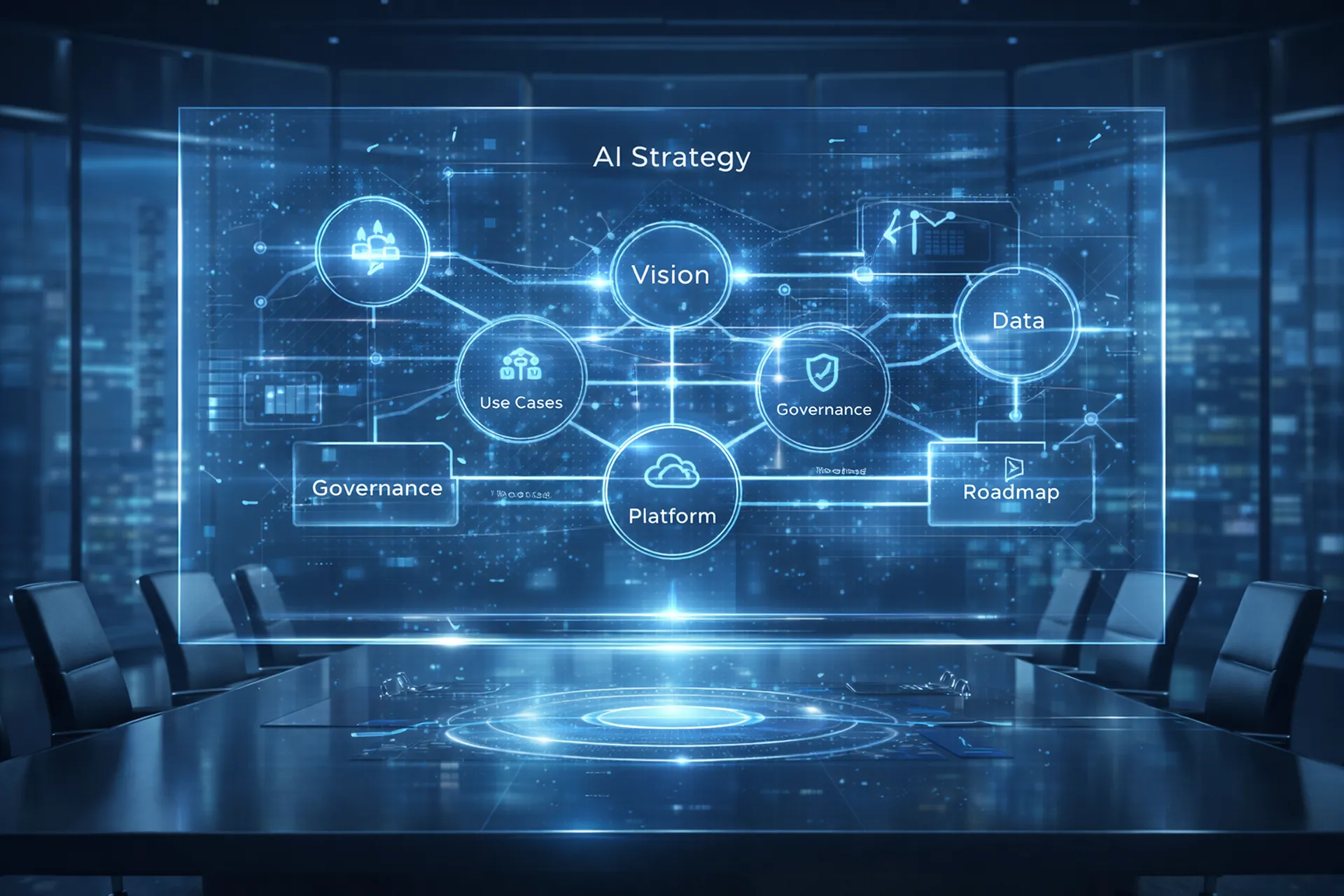
AI Strategy & Digital Transformation Consulting. Expert AI consult services drive digital transformation. Craft your AI strategy with our artificial intelligence consulting.
