Industrial sectors are standing at the edge of their most significant transformation in a generation. Industrial AI — artificial intelligence purpose-built for the complex, high-stakes environments of manufacturing, energy, logistics, and infrastructure — is no longer a future ambition. It is a present-day competitive necessity. From predictive maintenance on factory floors to agentic AI systems that autonomously optimize global supply chains, the power of industrial AI is reshaping what is operationally possible for enterprises that are bold enough to embrace it. This guide breaks down exactly what industrial AI is, what it does, where it creates the most value, and how your organization can harness it to accelerate business growth — starting now.
What Is Industrial AI and Why Is It Different from Generic AI?
Industrial AI refers to the application of artificial intelligence — including machine learning, computer vision, generative AI, and agentic AI — specifically within industrial environments and operational contexts. Unlike generic AI tools designed for broad consumer or office use, industrial AI is engineered to meet the unique demands of manufacturing, energy, logistics, infrastructure, and other asset-intensive industries. It combines deep domain expertise with advanced AI models trained on industrial data — sensor readings, equipment logs, production records, quality inspection images — to deliver insights and automation that generic AI simply cannot provide.
Industrial artificial intelligence refers to a class of AI solutions tailored to the operational realities of industry: real-time processing of high-frequency data streams, integration with legacy operational technology systems, safety-critical decision-making, and the need for extreme reliability in environments where downtime is measured in millions of dollars per hour. This is why industrial AI systems are built differently from enterprise software designed for back-office functions. They must operate under conditions of noise, variability, and physical consequence that consumer AI platforms were never designed to handle.
The distinction matters enormously for organizations evaluating AI adoption. A generic AI platform may offer impressive capabilities in a controlled demonstration but struggle to deliver business value in the complexity of real industrial operations. Industrial AI applies decades of industry experience and deep domain expertise to ensure that AI models are calibrated to actual industrial processes, integrated with the data sources that matter, and governed with the safety and reliability standards that industrial sectors demand. Our AI consulting team helps enterprises navigate exactly this distinction — identifying which AI solutions are genuinely fit for industrial deployment and which fall short under real-world conditions.
How Is Industrial AI Transforming Manufacturing and Production Operations?
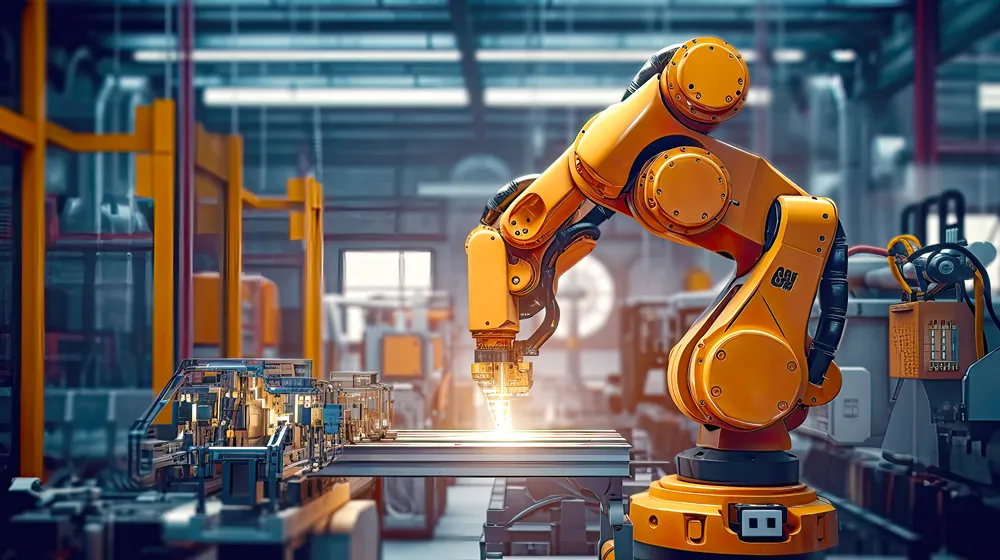
AI in manufacturing is delivering transformation across every stage of the production lifecycle. On the factory floor, AI-powered computer vision systems inspect products at speeds and accuracy levels no human quality control team can match — catching defects in real time before they progress further down the production line. AI automates the analysis of sensor data from production equipment, identifying subtle patterns that precede quality deviations and enabling operators to intervene before defective batches are produced. Improving product quality through AI is no longer a pilot project for leading manufacturers — it is a core operational capability.
Predictive maintenance is one of the highest-value use cases in the manufacturing industry, and industrial AI has made it dramatically more accessible and accurate. Traditional maintenance schedules are based on fixed intervals — machines are serviced whether or not they need it, which wastes resources, or they run until failure, which causes costly unplanned downtime. Industrial AI uses sensor data, vibration analysis, thermal imaging, and historical failure records to predict with high accuracy when specific components are approaching failure, enabling maintenance to be scheduled at exactly the right time. The result is a significant reduction in downtime, extended asset lifespan, and maintenance cost savings that compound across large equipment fleets.
AI in manufacturing also transforms production planning and scheduling. Manufacturing challenges like demand volatility, supply disruptions, and capacity constraints create planning complexity that overwhelms traditional rule-based systems. AI solutions powered by machine learning can ingest demand signals, inventory levels, supplier lead times, and production capacity data simultaneously, generating optimized production schedules that balance efficiency and agility in real time. Cloud-based manufacturing platforms equipped with these AI capabilities are enabling manufacturers to respond to market changes faster than ever before, turning supply chain responsiveness into a genuine competitive advantage. Explore how our enterprise AI development services support manufacturing organizations building these capabilities at scale.
What Are the Most Valuable Industrial AI Use Cases Across Sectors?
Industrial AI use cases span a remarkably broad range of sectors and functions, each delivering measurable business value in ways specific to their operational context. In energy and utilities, industrial AI optimizes grid management, forecasts renewable energy generation, and manages demand response programs that balance supply and consumption in real time. AI-powered asset management in energy infrastructure detects equipment degradation early, reducing the risk of catastrophic failures in critical systems like pipelines, turbines, and substations. Our work across the energy sector demonstrates how industrial AI delivers both operational savings and sustainability outcomes simultaneously.
In healthcare, industrial AI processes electronic health records — EHR data — to surface clinical insights that improve diagnostic accuracy, flag patients at risk of deterioration, and optimize care pathway decisions. AI provides clinicians with decision support that synthesizes vast quantities of patient data into actionable recommendations, reducing cognitive load and improving outcomes. In insurance, industrial AI transforms underwriting and claims processing by automating risk assessment, accelerating claims adjudication, and detecting fraud patterns that human reviewers would miss. In fintech, AI powers real-time credit decisioning, anti-money laundering surveillance, and algorithmic trading systems that operate at speeds no human team could match.
In retail, AI uses demand forecasting, personalization engines, and inventory optimization to reduce waste and increase revenue simultaneously. In transportation and logistics, industrial AI optimizes routing, fleet management, and demand-responsive scheduling across networks of extraordinary complexity. The common thread across all these industrial AI use cases is the combination of domain expertise with AI technologies — solutions tailored to the specific data, workflows, and decision-making requirements of each industry rather than generic AI tools applied without context.

What Role Does Agentic AI Play in Industrial Automation?
Agentic AI represents the next frontier of industrial automation — and it is arriving faster than most organizations anticipated. Where earlier generations of industrial AI provided recommendations for human operators to act on, agentic AI takes autonomous action: planning multi-step workflows, calling external systems and data sources, making sequential decisions, and adapting in real time to changing conditions — all without requiring human intervention at each step. This shift from AI as a decision-support tool to AI as an autonomous operational agent is fundamentally changing what industrial automation can achieve.
In industrial operations, AI agents are being deployed to manage complex processes end-to-end. An AI agent might monitor production line sensor data, detect an anomaly indicating imminent equipment failure, automatically trigger a maintenance work order, reschedule affected production runs, notify the supply chain team about potential delays, and update customer delivery estimates — all within minutes and without a human touching the workflow. This level of autonomous coordination across systems and stakeholders was impossible with traditional automation software and only becomes achievable through the integration of agentic AI with industrial data infrastructure. Our AI agents development team specializes in building exactly these kinds of end-to-end autonomous industrial workflows.
The implications for industrial automation strategy are profound. Organizations that deploy AI agents within their operations can achieve levels of operational efficiency and responsiveness that competitors relying on conventional automation simply cannot match. At the same time, deploying agentic AI in industrial environments requires careful design — robust guardrails, human oversight mechanisms, and fail-safe architectures that ensure autonomous AI decision-making stays within defined operational boundaries. Getting this balance right is what separates successful industrial AI deployments from costly failures.
How Does Generative AI Add Value in Industrial Settings?
Generative AI is finding powerful applications in industrial settings that go well beyond the content creation use cases most commonly associated with it. In engineering and product development, generative AI accelerates design iteration by proposing novel configurations, materials, and structural approaches based on performance requirements — dramatically compressing design cycles that once took months. AI models trained on engineering data can generate design alternatives that human engineers then evaluate and refine, combining the creativity of generative AI with the judgment and domain expertise of experienced practitioners.
In industrial operations, generative AI is transforming technical documentation, maintenance procedures, and operator training. AI software can generate natural-language explanations of complex equipment failure modes, draft standard operating procedures from structured data, and create training simulations that prepare operators for rare but high-consequence scenarios. These generative AI applications accelerate knowledge transfer across large industrial workforces — a critical capability as experienced operators retire and organizations face the challenge of preserving institutional knowledge at scale.
Generative AI also powers the conversational interfaces that make industrial AI systems accessible to frontline workers. Rather than requiring operators and technicians to navigate complex dashboards, generative AI enables natural-language interaction with industrial data — asking questions, requesting reports, and receiving guidance in plain language. This democratization of AI access across the industrial workforce is one of the most important benefits of bringing generative capabilities into industrial AI platforms. Our conversational AI development services help industrial organizations build these intuitive AI interfaces for their frontline teams.
How Does Industrial AI Optimize Supply Chain and Logistics Operations?
The global supply chain has become one of the highest-priority targets for industrial AI investment, and for good reason. Supply chain complexity — spanning thousands of suppliers, multiple transportation modes, fluctuating demand signals, and geopolitical disruptions — generates a scale of data and decision-making challenge that traditional analytics cannot address. Industrial AI processes this complexity in real time, continuously optimizing inventory positioning, supplier selection, logistics routing, and demand forecasting across networks of extraordinary scale.
AI to automate supply chain decision-making delivers speed and consistency that human planners cannot sustain across thousands of simultaneous decisions. Industrial AI systems can evaluate hundreds of supply chain scenarios simultaneously — assessing the impact of a supplier disruption, a port closure, or a demand spike on downstream inventory and delivery commitments — and recommend or autonomously implement optimal responses within minutes. This real-time optimization capability transforms supply chain management from a reactive, firefighting exercise into a proactive, intelligence-driven operation. Organizations in manufacturing and construction are already capturing significant competitive advantage through AI-powered supply chain optimization.
Predictive analytics powered by industrial AI also enables organizations to anticipate supply disruptions before they materialize. By monitoring supplier financial health, geopolitical risk indicators, commodity price trends, and logistics network performance data simultaneously, AI provides early warning of potential supply chain vulnerabilities — giving procurement and operations teams time to build contingency plans rather than react to crises. The combination of predictive and prescriptive AI in supply chain management is one of the clearest examples of how industrial AI drives measurable business value that flows directly to the bottom line.
What Are the Key Capabilities of Leading Industrial AI Platforms?
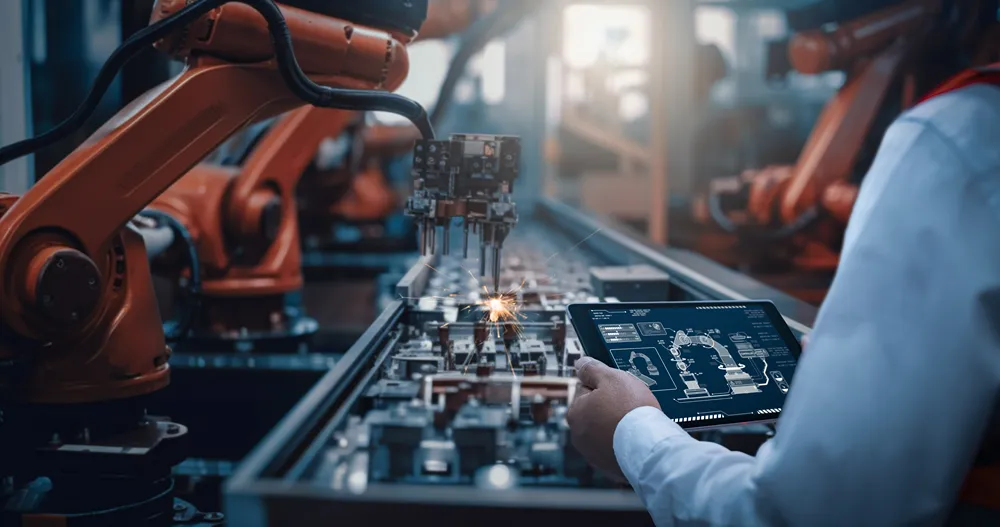
Industrial AI platforms are purpose-built environments that bring together the data integration, model development, deployment, and monitoring capabilities that industrial AI requires. Unlike general-purpose machine learning software, industrial AI platforms are designed with the specific data types, integration requirements, and operational constraints of industrial environments in mind. They provide pre-built connectors for industrial data sources — historians, SCADA systems, ERP platforms, IoT sensor networks — and include domain-specific AI models that accelerate time to value by incorporating industrial knowledge that would otherwise require years to build from scratch.
The C3 AI Platform is one example of an enterprise AI platform specifically designed for industrial and enterprise use cases — offering pre-built AI applications for predictive maintenance, supply chain optimization, energy management, and fraud detection that can be deployed and customized within weeks rather than months. More broadly, leading industrial AI platforms differentiate on three dimensions: the quality of their pre-built domain models, the robustness of their real-time data processing capabilities, and the ease with which their AI applications can be integrated into existing industrial workflows without disrupting operations. AI platforms that excel on all three dimensions deliver the fastest path from AI investment to operational impact.
AI provides the most value when industrial AI platforms are designed for scale — capable of handling the volume, velocity, and variety of data generated by large industrial operations while maintaining the real-time performance that operational decision-making requires. The best platforms also support continuous learning: as industrial conditions evolve, AI models update automatically from new data, ensuring that the intelligence embedded in the platform stays current with the operational reality it is designed to optimize. Our process orchestration platform provides this kind of adaptive, continuously learning foundation for enterprise AI deployments across industrial sectors.
How Should Enterprises Approach Industrial AI Adoption?
Successful AI adoption in industrial settings requires a structured approach that balances ambition with operational pragmatism. The most common mistake organizations make is launching too broadly — attempting to deploy AI across multiple use cases simultaneously without the data infrastructure, change management, or governance frameworks to support them. Industrial AI adoption works best when it starts with a focused, high-value use case where the data is available, the business case is clear, and success can be demonstrated visibly to the broader organization.
The second critical factor is data readiness. Industrial AI systems are only as good as the data that feeds them, and industrial data environments are typically fragmented across multiple systems — operational technology, enterprise resource planning, maintenance management, and quality management systems — that were never designed to work together. Before deploying AI, organizations must invest in data integration and quality: ensuring that sensor data is reliable, operational records are complete, and data pipelines are robust enough to support real-time AI inference. This foundational work is less exciting than the AI itself, but it is what determines whether AI delivers lasting business value or produces unreliable outputs that erode trust.
Integrate AI into existing workflows — not as a parallel system that operators must check separately — is the third key to successful industrial AI adoption. AI decision-making is most effective when it is embedded directly into the tools and processes that industrial workers already use, surfacing insights at the moment of decision rather than requiring separate consultation. Organizations that get this integration right see rapid adoption and measurable productivity gains. Those that bolt AI onto the side of existing workflows find that even excellent AI goes unused. Our enterprise AI consulting services guide organizations through all three dimensions of industrial AI adoption — from use case prioritization through data readiness to workflow integration and change management.
What Are the Challenges of Deploying AI in Complex Industrial Environments?
Deploying AI in industrial environments introduces challenges that are distinct from those encountered in commercial or office settings. The most fundamental is operational technology integration. Industrial environments run on specialized control systems — PLCs, DCS, SCADA — that were designed for reliability and determinism, not for the open data exchange that AI requires. Integrating AI with these systems without compromising their safety and reliability requires specialized engineering expertise that sits at the intersection of IT and OT — a combination of skills that is genuinely scarce.
Safety and reliability standards add another layer of complexity. In industrial sectors like energy, aerospace, and chemical processing, AI systems that influence physical operations must meet regulatory standards for functional safety — requirements that are far more demanding than those applied to enterprise software. AI solutions deployed in these environments must be validated extensively, fail-safe in their behavior, and auditable in their decision-making. This is why solutions for diverse industrial sectors must be designed with safety-by-design principles embedded from the architecture level up, not added as an afterthought during deployment.
Change management is often the most underestimated challenge in industrial AI deployment. Industrial workforces have deep operational experience and well-founded skepticism toward technologies that promise to automate their judgment. AI adoption succeeds in industrial environments when it is positioned as a tool that enhances worker capability — augmenting human expertise rather than replacing it — and when frontline workers are involved in the design and validation of AI applications from the beginning. Organizations that treat industrial AI as a purely technical implementation, without investing equally in the human dimensions of change, consistently underperform those that bring their operational workforce along as active participants in the AI transformation journey. McKinsey's research on industrial AI adoption shows that workforce engagement is among the top predictors of successful AI value realization in industrial settings.

What Is the Future of Industrial AI and Where Is It Headed?
The future of industrial AI is defined by three converging trajectories: the maturation of agentic AI, the proliferation of edge AI, and the deepening integration of AI with physical systems through Industry 4.0 architectures. As agentic AI systems become more capable and more trusted, the scope of autonomous industrial decision-making will expand dramatically — from individual process optimization to end-to-end autonomous management of complex industrial systems. This progression will require industrial AI to develop increasingly sophisticated reasoning capabilities, multi-agent coordination frameworks, and human-AI collaboration interfaces that keep human operators meaningfully in the loop without creating bottlenecks.
Edge AI — the deployment of AI models directly on industrial hardware at the point of data generation — will transform industries where real-time response requirements cannot tolerate the latency of cloud processing. Smart sensors, intelligent actuators, and edge AI inference chips will embed intelligence directly into industrial assets, enabling autonomous response to process conditions at millisecond timescales. This development accelerates innovation across industries like smart cities, autonomous vehicles, precision agriculture, and advanced manufacturing, where the gap between sensing a condition and responding to it must be measured in milliseconds rather than seconds. MIT Technology Review's coverage of industrial AI provides excellent deep dives into how these edge AI architectures are developing.
The power of industrial AI will ultimately be realized through the accumulation of domain knowledge embedded in AI systems over time. Each deployment generates new operational data, each new dataset improves model accuracy, and each improvement unlocks new use cases — creating a compounding cycle of industrial AI capability that widens the gap between organizations that invested early and those that delayed. The future of industrial AI belongs to organizations that treat AI not as a project with a defined end date, but as a continuous capability that grows more valuable with every operational cycle. The question for industrial leaders in 2026 is not whether to invest in industrial AI — it is how quickly and how strategically to build the AI foundation that will power the next decade of industrial competitive advantage. Discover how VisioneerIT AI's full portfolio of services supports every stage of that journey.
Key Takeaways: What to Remember About Industrial AI
- Industrial AI refers to artificial intelligence purpose-built for the operational demands of manufacturing, energy, logistics, healthcare, and other asset-intensive industries — combining domain expertise with advanced AI to deliver outcomes generic AI cannot
- Predictive maintenance is one of the highest-value industrial AI use cases, reducing unplanned downtime, extending asset lifespan, and converting maintenance from a cost center into a strategic capability
- Agentic AI represents the next evolution of industrial automation — autonomous AI agents that plan, act, and adapt across complex industrial workflows without requiring human intervention at every step
- Generative AI in industrial settings accelerates engineering design, transforms technical documentation, and powers the conversational interfaces that make industrial AI accessible to frontline workers
- Supply chain optimization through industrial AI delivers real-time responsiveness to disruptions, demand volatility, and logistics complexity at a scale and speed that traditional analytics cannot match
- Industrial AI platforms must be evaluated on domain model quality, real-time data processing capability, and workflow integration depth — not just on general AI benchmarks
- Successful AI adoption in industrial environments requires focused use case prioritization, data readiness investment, and deep workflow integration — not broad simultaneous deployment
- Deploying AI in industrial environments requires specialized OT integration expertise, functional safety compliance, and robust change management — all of which are as important as the AI technology itself
- The future of industrial AI is defined by agentic systems, edge AI deployment, and the compounding accumulation of domain knowledge that makes industrial AI more valuable with every operational cycle
- Organizations that invest now in building industrial AI capabilities will compound that advantage into lasting competitive leadership — while those that delay face an increasingly difficult gap to close
VisioneerIT AI delivers smart, secure, and scalable AI solutions that help businesses innovate, automate, and grow with confidence. Ready to unlock the power of industrial AI for your organization? Talk to our team today.
